Electrical
EV charger in Andorra: installing one at home or in a shared garage
What power to choose, what changes if your space is in a shared garage, what protection the installation must have and why the cold affects charging.
· 5 min read · Andorra Servei
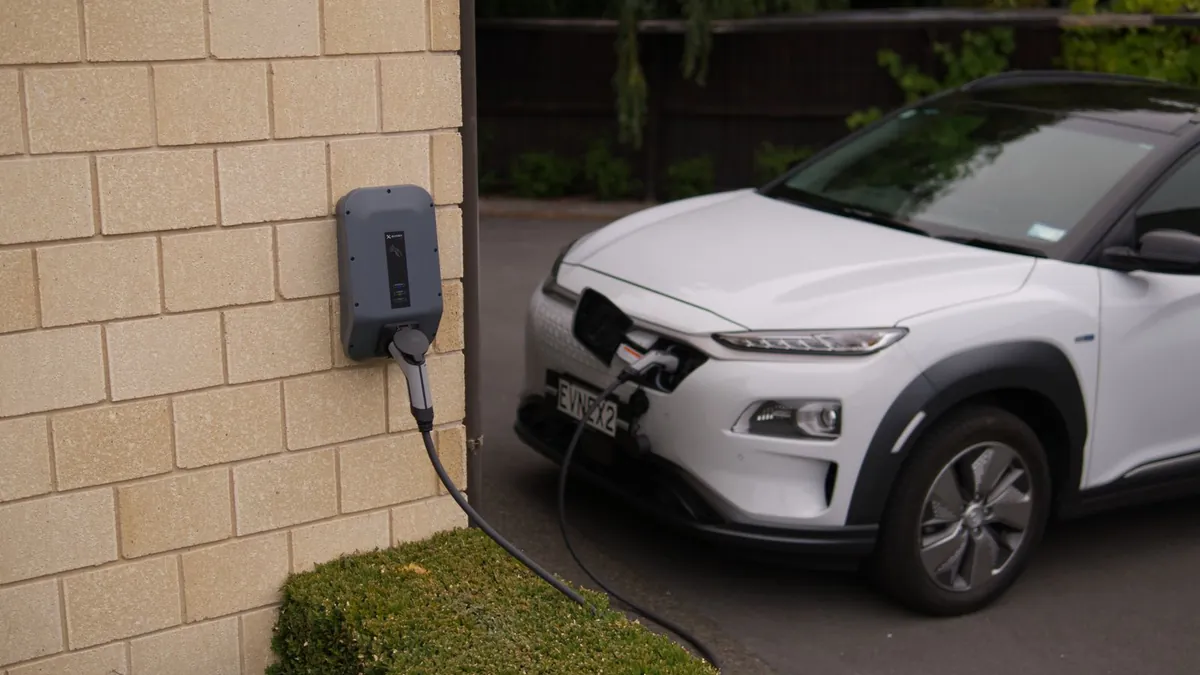
To charge an electric car at home in Andorra, the usual choice is a single-phase wall-mounted charging point of 3.7 to 7.4 kW, fed by a dedicated circuit from the consumer unit. At 7.4 kW, a medium-sized battery fills up overnight. A domestic socket will do in an emergency, but it is not designed to run for hours at full load every day.
What power to choose
| Power | Supply | Range added per hour (approx.) |
|---|---|---|
| 2.3 kW (socket) | Single-phase | 10 – 15 km |
| 3.7 kW | Single-phase | 20 – 25 km |
| 7.4 kW | Single-phase | 40 – 50 km |
| 11 kW | Three-phase | 60 – 70 km |
More power is not always better: it depends on the car's on-board charger, your contracted power and how far you drive each day. For daily journeys within the Principality, 3.7 kW overnight is usually more than enough. Chargers with dynamic load management measure the home's consumption and reduce the charging rate when the oven or the heating comes on, so in many cases there is no need to contract more power.
In a detached house
- Checking the consumer unit and the contracted power. We see whether there is space and headroom; if not, the consumer unit is extended or the increase is arranged with the electricity company.
- A dedicated circuit from the consumer unit to the garage, with the cable size the distance calls for.
- Protection: a circuit breaker, an RCD suitable for vehicle charging and surge protection.
- Fitting the charger, setting it up and testing it with the car.
For a straightforward installation, the job is done in a day.
In a shared garage
This is the most common case in Andorra la Vella and Escaldes-Engordany, and there are two matters to settle first:
- The owners' association. The cable crosses common areas, so the building's owners' association has to be notified and its rules followed. It helps to submit a simple diagram of the route to head off objections.
- Where the supply comes from. The cleanest solution is to run the cable from your own home's meter to the parking space. When the distance makes that unworkable, we look at a branch connection with a sub-meter or a collective pre-installation that leaves the garage ready for future charging points.
If several neighbours are going to install a charger, doing it together brings down the cost of the cable routes and avoids covering the garage ceiling with separate conduits.
The cold matters too
At sub-zero temperatures the battery accepts less power and the car uses energy to warm it up. Three tips for the Andorran winter:
- If the space is outdoors, a charger rated IP54 or higher, with the cable stowed away rather than left lying in the snow.
- Schedule charging to finish shortly before you set off: the battery will be warm.
- Pre-heat the cabin while the car is plugged in, so you do not use up range on heating.
What affects the price
The charger itself is only part of it. The rest depends on the length of the cable run, whether it is surface-mounted or the walls have to be chased, the condition of the consumer unit and whether the contracted power needs increasing. That is why the quote is prepared after seeing the installation. The Andorran Government has run grant schemes for electric mobility; the conditions change with each call for applications, and it is worth checking the current one.
If you also have, or are considering, solar panels, the charger can be programmed to make use of the midday surplus. You will find the details of our work under electrical services in Andorra; for a quote, send us through the form a photo of the consumer unit and the approximate distance to the parking space.
Frequently asked questions
Can I charge an electric car from an ordinary socket?
Occasionally, yes. For everyday use it is not recommended: a domestic socket is not designed to run for hours at full load, and charging is very slow.
Do I need to increase my contracted power?
Not always. A charger with dynamic load management adjusts the charging rate to what the home is using at any given moment, and in many cases avoids the increase.
Can I install a charger in my space in a shared garage?
Yes, by notifying the owners' association beforehand and following its rules, because the cable runs through common areas. We prepare the route diagram for you to submit.